

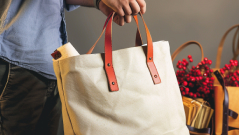


Dyeing and finishing technology are central to both the appearance and practicality of canvas bags. Traditional canvas was often produced using an immersion dyeing process, in which the fabric was fully soaked in dye to ensure even color penetration. However, this method often had limitations in color fastness. Today, the mainstream solution is high-temperature, high-pressure dyeing technology, which dyes the fabric in a pressurized environment at 120-130°C. This allows dye molecules to bond more stably with the fibers, achieving a washing color fastness of Grade 4 or above and effectively reducing fading. Some functional canvas bags also incorporate water-repellent finishing technology, with a polytetrafluoroethylene coating applied to the fabric surface to form a micron-level protective film that can resist light rain without compromising breathability.
The optimization of structural craftsmanship further improves the usability of canvas bags. The seams of the bag body commonly use double-needle stitching technology, with stitch density controlled at 3 to 4 stitches per centimeter. Compared with single-needle stitching, this method doubles the tensile strength and enables the bag to withstand the pulling force of heavier items. The shoulder straps often adopt a sandwich structure, with high-density foam or nylon webbing inserted in the middle and wrapped in canvas on the outside. This structure is secured through a high-temperature lamination process, which not only enhances load-bearing capacity but also helps distribute pressure across the shoulders. As for accessories such as zippers and snap buttons, their installation usually involves three steps: positioning and punching, reinforced stitching, and tensile testing. This ensures that the accessories are firmly connected to the bag body and gives the bag a service life of more than three years.
From traditional weaving to modern process upgrades, the technological evolution of canvas bags has not only preserved their core advantage of durability, but also responded to consumers' expectations for aesthetics, comfort, and multifunctionality, allowing this classic item to remain relevant and vibrant in the modern era.